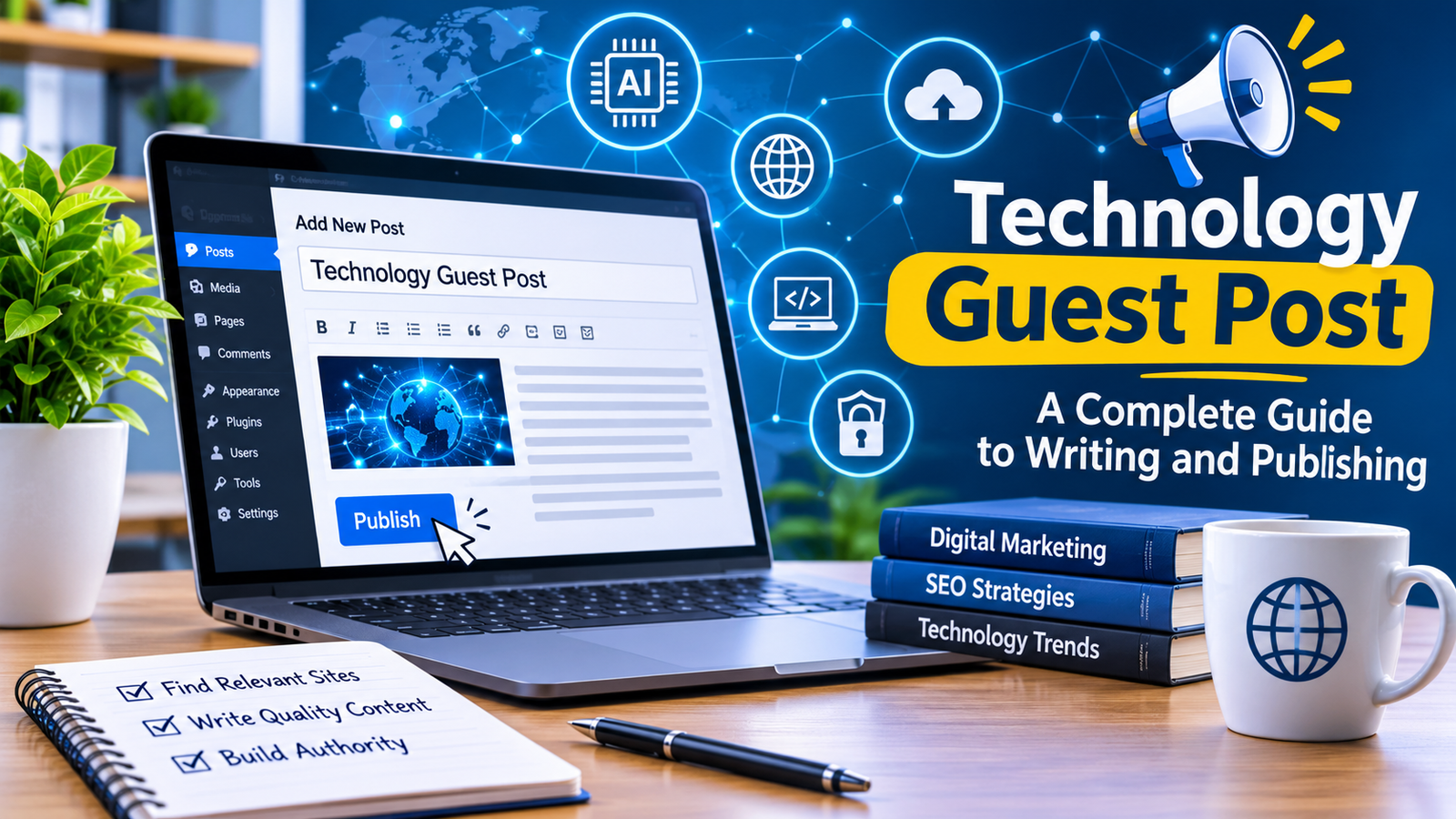
Technology Guest Post: A Complete Guide to Writing and Publishing
Introduction :
Technology is constantly evolving, changing how people communicate, work, learn, and run businesses. From artificial intelligence and cloud computing to cybersecurity and software development, technology has become an important part of everyday life. As the technology industry continues to grow, businesses, bloggers, and digital marketers are looking for effective ways to reach new audiences and establish their online presence.
One popular strategy is publishing a technology guest post on relevant websites. Guest posting allows writers and businesses to share useful knowledge, connect with readers, build industry relationships, and increase brand visibility.
Whether you are a technology blogger, startup owner, software developer, or digital marketer, understanding how technology guest blogging works can help you create valuable content and reach the right audience.
In this guide, we will explore the meaning of technology guest posts, their benefits, how to find relevant websites, and the best practices for publishing high-quality guest articles.
What Is a Technology Guest Post?
A technology guest post is an article written by an individual, business, or content creator and published on another website that covers technology-related topics.
These articles generally provide useful information about subjects such as software, artificial intelligence, gadgets, cybersecurity, mobile applications, digital innovation, and emerging technologies.
Guest contributors write content that matches the host website’s audience and editorial guidelines. In return, they may receive author recognition, brand exposure, referral traffic, and sometimes a relevant link to their website.
For example, a software development company might publish an article about the latest software development trends on a technology blog. This allows the company to share its knowledge with an established audience while providing valuable information to readers.
Why Are Technology Guest Posts Important?
Technology guest blogging offers several opportunities for individuals and businesses that want to establish credibility in the technology industry.
Instead of publishing every article on your own website, contributing to relevant publications helps introduce your expertise to readers who may not have discovered your brand otherwise.
1. Increase Brand Awareness
Publishing articles on established technology websites can introduce your business to a wider audience.
When readers find your content useful, they may become interested in your company, products, services, or other published resources.
Consistent contributions to relevant publications can also help establish a recognizable online presence.
2. Build Industry Authority
Authority develops when you consistently share accurate, helpful, and valuable information.
By contributing well-researched articles about software, cybersecurity, artificial intelligence, and other technology subjects, you can demonstrate your knowledge and establish credibility with readers.
However, authority comes from the quality and reliability of your contributions rather than simply the number of guest articles published.
3. Generate Relevant Referral Traffic
A guest article can introduce your website to readers who are already interested in your industry.
When an editor permits a relevant contextual link, interested readers may visit your website to explore additional information.
This can generate targeted referral traffic and introduce potential customers to your services.
4. Support SEO and Link Building
Guest contributions can support an overall SEO strategy when they are published on relevant, trustworthy websites.
An editorial backlink may help search engines discover related pages and understand connections between websites.
However, links created primarily to manipulate search rankings can violate Google’s spam policies. Focus on editorial value, genuine relevance, and natural linking rather than purchasing or exchanging links solely for ranking purposes.
5. Build Professional Relationships
Working with technology editors, publishers, developers, and industry experts creates opportunities to develop professional relationships.
These connections may lead to future collaborations, interviews, partnerships, and additional publishing opportunities.
Popular Topics for Technology Guest Posts
Choosing the right subject is essential for creating content that attracts readers and satisfies a website’s editorial requirements.
Here are some popular technology categories worth exploring.
Artificial Intelligence and Machine Learning
Artificial intelligence is transforming industries through automation, predictive analytics, intelligent assistants, and data processing.
Potential article ideas include:
- How Artificial Intelligence Is Changing Modern Businesses
- Practical Applications of Machine Learning
- AI Tools That Improve Workplace Productivity
- The Future of Generative AI
- Benefits and Challenges of AI Automation
Software Development
Software development remains an important part of digital innovation.
Possible topics include:
- Modern Software Development Trends
- Frontend vs. Backend Development
- Why Businesses Need Custom Software
- Understanding Application Programming Interfaces
- Best Practices for Secure Software Development
Cybersecurity and Online Privacy
As businesses and individuals depend increasingly on digital platforms, protecting information has become essential.
Relevant guest post ideas include:
- Essential Cybersecurity Practices for Small Businesses
- How to Protect Personal Information Online
- Understanding Common Cybersecurity Threats
- The Importance of Data Encryption
- Password Security Best Practices
Mobile Technology and Applications
Mobile devices and applications have changed how people access information, communicate, and complete everyday tasks.
You can explore topics such as:
- Mobile App Development Trends
- How Smartphones Are Changing Daily Life
- Android vs. iOS: Understanding the Differences
- Mobile Application Security
- The Future of Mobile Technology
Cloud Computing and Data Storage
Cloud computing enables organizations to access computing resources and store information without maintaining all infrastructure locally.
Potential article subjects include:
- Benefits of Cloud Computing for Businesses
- Public Cloud vs. Private Cloud
- Understanding Cloud Storage
- Cloud Security Best Practices
- How Businesses Use Cloud-Based Applications
Gadgets and Consumer Technology
Consumer technology is another popular category for guest blogging.
Possible topics include:
- Latest Technology Trends in Consumer Electronics
- Features to Consider Before Buying a Laptop
- How Wearable Technology Works
- Smart Home Technology Explained
- The Future of Wireless Devices
How to Find Technology Guest Posting Websites
Finding suitable publishing opportunities is an important part of a successful guest blogging strategy.
Rather than submitting articles to every website that accepts contributions, prioritize publications that cover your subject and have an audience relevant to your goals.
1. Use Google Search Operators
Google search operators can help you discover websites that accept guest contributions.
Try searches such as:
technology "write for us"tech blog "guest post"technology "submit an article"technology "guest contribution"software "write for us"cybersecurity "become a contributor"technology blog "submit guest post"
These searches can reveal editorial guidelines, contributor pages, and relevant publishing opportunities.
2. Analyze Website Relevance
Before contacting a website, check whether its content matches your proposed article.
Consider the following factors:
- Does the website regularly publish technology content?
- Is its audience relevant to your topic?
- Are its articles informative and original?
- Does it have a consistent publishing history?
- Does it provide clear editorial guidelines?
- Does it demonstrate genuine readership and engagement?
A smaller but highly relevant publication may be more valuable than a large website with unrelated content.
3. Check Website Quality
Evaluate the website before submitting your work.
Review its content quality, reputation, editorial standards, organic visibility, and outbound linking practices.
Do not rely exclusively on third-party metrics such as Domain Authority or Domain Rating. These are useful comparative indicators, not official Google ranking factors.
4. Read Guest Posting Guidelines
Most reputable publications have specific contributor requirements.
Some websites require original articles, author biographies, minimum word counts, references, or particular formatting.
Following these requirements increases the likelihood that your submission will be considered.
How to Write a High-Quality Technology Guest Post
A successful guest article should provide genuine value to readers instead of focusing entirely on promotional content.
Follow these steps to create a professional and informative article.
1. Select a Relevant Topic
Start by understanding the website’s audience and identifying subjects that match its content.
Choose a topic that answers a real question, solves a problem, or explains an important technology concept.
2. Research the Subject
Use trustworthy resources, technical documentation, industry reports, and original research to support your information.
Technology changes quickly, so verify statistics, product information, software features, and technical claims before publication.
3. Create a Clear Article Structure
Organize your content using descriptive headings and logical sections.
A useful structure includes:
- Introduction
- Explanation of the main topic
- Important benefits or features
- Practical examples
- Challenges or considerations
- Actionable recommendations
- Conclusion
4. Write Original and Readable Content
Avoid copying information from other websites or rewriting existing articles without adding meaningful value.
Use straightforward language, short paragraphs, relevant examples, and clear explanations.
Your article should be understandable to the intended audience, whether readers are beginners or experienced technology professionals.
5. Add Relevant References and Links
Support important claims with trustworthy references.
When appropriate, link to technical documentation, research papers, official technology websites, and useful resources.
Only include links that help readers understand the subject.
6. Optimize the Article for SEO
Use your primary keyword naturally in the title, introduction, relevant headings, and conclusion where appropriate.
Include related terms and relevant subtopics to provide comprehensive coverage.
Avoid repeating the same keyword unnecessarily. Search optimization should improve clarity and relevance rather than make the article sound unnatural.
7. Proofread Before Submission
Review your article for spelling, grammar, factual accuracy, readability, formatting, and broken links.
Make sure it follows the publisher’s requirements before submitting it.
Best Practices for Successful Technology Guest Blogging
To achieve sustainable results, follow these recommended practices:
- Prioritize relevant technology publications.
- Write original and helpful content.
- Follow the publisher’s editorial guidelines.
- Avoid excessive promotional language.
- Use trustworthy sources and accurate information.
- Include links only when they provide genuine value.
- Build long-term relationships with editors.
- Update outdated information when necessary.
- Avoid spammy link exchanges and paid link schemes.
- Track referral traffic and engagement.
These practices help create a more effective guest blogging strategy while maintaining content quality.
Common Technology Guest Posting Mistakes to Avoid
Even well-written articles can underperform when the publishing strategy is poorly planned.
Here are some mistakes to avoid.
Publishing on Irrelevant Websites
Submitting a cybersecurity article to an unrelated entertainment website may not attract the right readers.
Always prioritize topical relevance.
Using Duplicate Content
Publishing the same article across multiple websites without meaningful differentiation can reduce its usefulness.
Create original contributions tailored to each publication.
Overusing Keywords
Excessive repetition of phrases such as technology guest post, technology blog, and guest blogging makes content difficult to read.
Use keywords naturally and include relevant variations.
Focusing Only on Backlinks
Guest blogging should not be treated as a shortcut for obtaining backlinks.
Prioritize audience value, industry expertise, brand visibility, and useful information.
Ignoring Editorial Requirements
Submitting an article that does not meet the publisher’s guidelines wastes time and reduces the chance of acceptance.
Read the requirements carefully before sending your content.
Future of Technology Guest Blogging
The technology publishing industry continues to evolve as new tools, platforms, and digital trends emerge.
Artificial intelligence, automation, cloud computing, cybersecurity, and software innovation will continue creating opportunities for knowledgeable contributors.
At the same time, publishers are becoming increasingly interested in original research, expert insights, practical examples, and trustworthy information.
Writers who focus on experience, accuracy, and audience needs will be better positioned to create meaningful contributions.
Guest blogging is therefore most effective when treated as a long-term content and relationship-building strategy rather than a quick link-building technique.
Conclusion
A technology guest post is an effective way to share knowledge, connect with industry audiences, and increase brand visibility.
By selecting relevant topics, researching carefully, creating original content, and following editorial guidelines, writers and businesses can develop valuable publishing opportunities.
Whether your interests include artificial intelligence, software development, cybersecurity, mobile applications, or cloud computing, focus on producing useful information that genuinely helps readers.
A consistent commitment to quality and relevance can make technology guest blogging a meaningful part of your wider content marketing strategy.
Additional SEO Strategy
1. Keyword Research and Placement
Use a combination of primary, secondary, and long-tail keywords.
| Keyword | Keyword type | Recommended placement |
|---|---|---|
| Technology guest post | Primary | Title, introduction, conclusion |
| Technology guest blogging | Secondary | Relevant H2 |
| Technology guest posting sites | Secondary | Dedicated section |
| Tech guest post opportunities | Long-tail | Website discovery section |
| Write for us technology | Long-tail | Finding websites section |
| Technology blog contributions | Related | Article body |
| Technology content marketing | Related | Benefits section |
| Technology industry trends | Related | Future section |
Keyword density recommendation: There is no officially required keyword density percentage from Google. Use the primary keyword naturally, approximately 5–10 times in this article if it reads naturally. Do not force additional repetitions just to reach a target.
2. Topic Cluster for Technology Guest Posts
Build topical authority by publishing supporting articles around your main guide.
PILLAR ARTICLE
Technology Guest Post: A Complete Guide
Main topic
Technology Guest Posting Sites
How to Write a Tech Guest Post
Technology Guest Post Benefits
Technology Write for Us Websites
Guest Blogging SEO Strategy
Technology Blog Outreach
Technology Content Marketing
Guest Post Editorial Guidelines
Publish each supporting article as a separate URL and connect it to the main guide with relevant internal links.
Recommended Supporting Articles
- Best Technology Guest Posting Sites for Bloggers
- How to Find Technology Blogs That Accept Guest Posts
- Benefits of Guest Blogging for Technology Businesses
- How to Write a Successful Technology Guest Article
- Technology Guest Posting and SEO: Best Practices
- How to Find Technology Write for Us Pages
- Guest Blogging Outreach: Tips for Beginners
- How to Evaluate Technology Websites Before Guest Posting
3. Internal Linking Strategy
If these pages exist on PediaVibe, use natural contextual links:
| Link from this article | Suggested anchor text | Link destination |
|---|---|---|
| Benefits section | SEO best practices | Your SEO guide |
| Topic section | Artificial intelligence | Your AI article |
| Topic section | Cybersecurity tips | Your cybersecurity article |
| Topic section | Software development | Your software article |
| Writing section | Content marketing strategy | Your content marketing guide |
| Conclusion | Digital marketing strategies | Your digital marketing guide |
Important: Do not create links to pages that do not exist. Publish the supporting articles first, then connect them naturally.
4. External Linking Strategy
Use authoritative sources to support your article’s factual and technical information.
Recommended external resources:
- Google Search Central — Official SEO documentation
- Google Search Essentials — Search Essentials
- NIST — Cybersecurity resources
- IBM — Technology insights
- Microsoft Learn — Technical documentation
Use external links where they support a particular statement. You do not need to link every source mentioned.
5. Canonical Tag
Recommended canonical URL
If this is the original and preferred version of the article, add this canonical tag to its HTML head:
<link rel="canonical" href="https://pediavibe.com/technology-guest-post/" />The canonical URL should be the preferred, indexable URL. Ensure that it matches the final published permalink, uses HTTPS, and is consistent with your website’s preferred domain.
6. Meta Data
| SEO field | Recommended content |
|---|---|
| SEO title | Technology Guest Post: Complete Guide to Guest Blogging |
| Meta description | Learn how technology guest posts work, find relevant publishing sites, write quality articles, and build brand authority with effective guest blogging. |
| Focus keyword | Technology Guest Post |
| URL slug | technology-guest-post |
| Robots | index, follow |
| Open Graph title | Technology Guest Post: A Complete Guide |
| Open Graph description | Discover technology guest blogging strategies, publishing opportunities, content tips, and SEO best practices. |
| OG type | article |
Suggested meta description is approximately 155 characters. Search engines may generate a different snippet.
7. Schema Markup
For this informational guide, use Article or BlogPosting structured data. The following example uses BlogPosting.
Replace the author, logo, and publication details with your actual website information before publishing.
<script type="application/ld+json">
{
  "@context": "https://schema.org",
  "@type": "BlogPosting",
  "mainEntityOfPage": {
    "@type": "WebPage",
    "@id": "https://pediavibe.com/technology-guest-post/"
  },
  "headline": "Technology Guest Post: A Complete Guide to Writing and Publishing",
  "description": "Learn how technology guest posts work, find relevant publishing sites, write quality articles, and build brand authority with effective guest blogging.",
  "image": "https://pediavibe.com/wp-content/uploads/technology-guest-post.jpg",
  "author": {
    "@type": "Organization",
    "name": "PediaVibe",
    "url": "https://pediavibe.com/"
  },
  "publisher": {
    "@type": "Organization",
    "name": "PediaVibe",
    "url": "https://pediavibe.com/"
  },
  "datePublished": "2026-11-12",
  "dateModified": "2026-11-12",
  "inLanguage": "en"
}
</script>
Important: Replace the sample image URL with the real uploaded image URL. Use the actual publication and modification dates. Structured data must accurately reflect visible page content. Validate it using Google’s Rich Results Test.
8. Featured Image Recommendation
For this article, use a professional technology-themed featured image.
Suggested image filename: technology-guest-post.jpg
Image alt text: Technology guest post and digital content publishing guide.
Image title: Technology Guest Post Guide
Image dimensions: 1200 × 675 pixels (16:9).
9. How to Get Your Article Indexed by Google
Follow these steps after publishing your article on PediaVibe.
- Publish your articleUpload the complete article to WordPress. Add the SEO title, meta description, featured image, and canonical URL.
- Check your robots settingsEnsure the page is not blocked by
noindexor robots.txt. - Submit your sitemapOpen Google Search Console and submit your XML sitemap.Usually:
https://pediavibe.com/sitemap_index.xml - Inspect your article URLUse URL Inspection in Google Search Console and enter:
https://pediavibe.com/technology-guest-post/ - Request indexingIf the page is accessible and eligible, click Request Indexing.
- Build internal linksLink to the article from relevant existing pages on your website.
- Validate structured dataUse Google Rich Results Test to check supported structured data.
- Monitor indexing statusRecheck the URL Inspection report and monitor impressions, clicks, and queries in Search Console.
Final SEO recommendation
For PediaVibe, I recommend publishing this as a pillar article and then creating the eight supporting articles in the topic cluster. This will help establish a connected technology content section.
Remember: Google indexing is not guaranteed, even after requesting indexing. Focus on original content, useful information, crawlability, and a strong internal linking structure.